It was a good day, Yesterday was a disaster—my bank acct was hacked and I had been working with that all morning in stead of painting. That was a terrible trade off. I used it as a springboard and finished 4 pieces today.
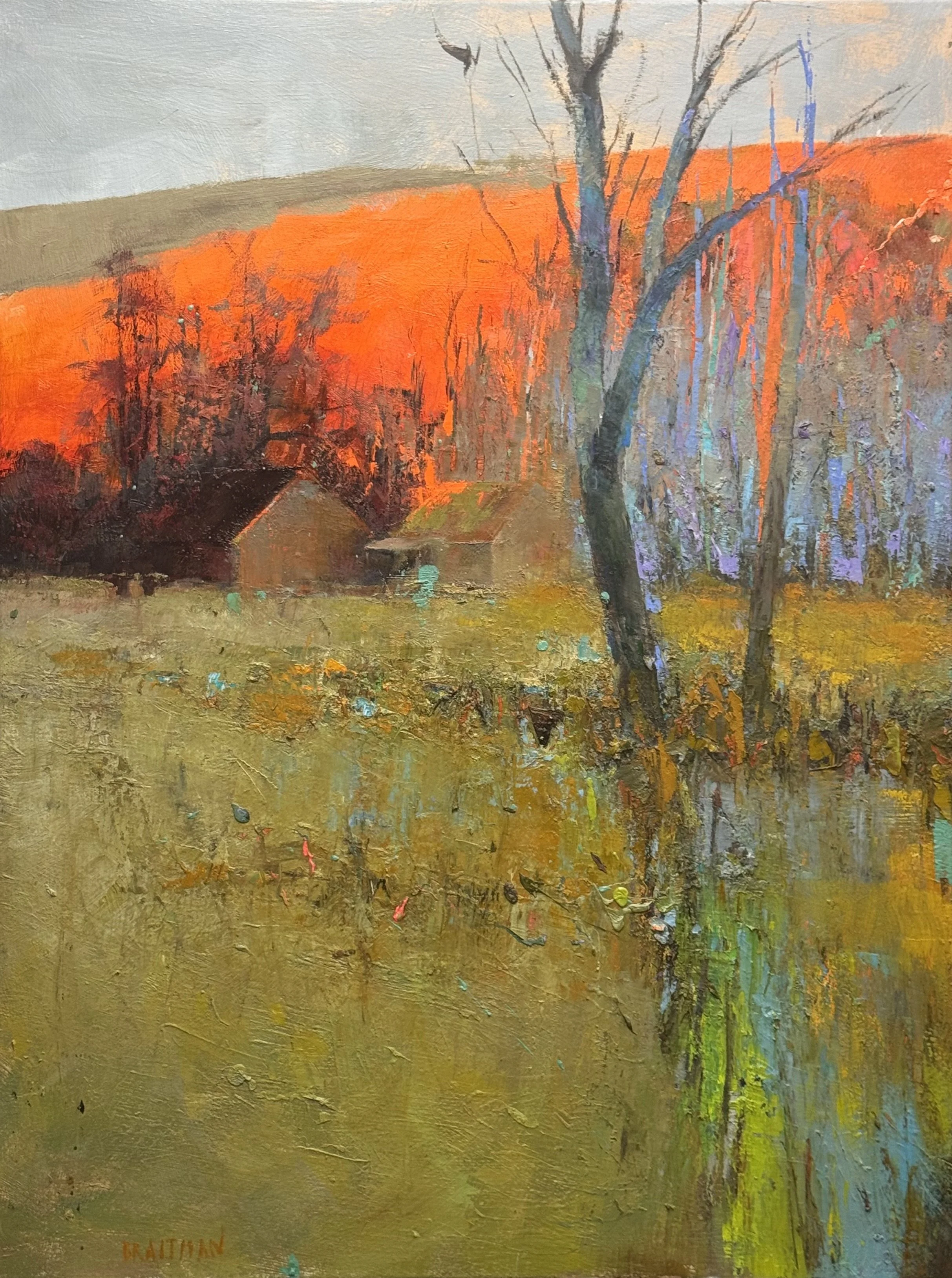
Every composition has a load-bearing element — the thing everything else leans on. Here it's the bare tree at right: a single dark vertical that anchors the foreground, splits the field from the tree line, and gives the eye somewhere to land before the orange hill takes over completely.
And that hill. Even before the final alizarin glaze, it's already close to combustion — a wall of heat pressing down on the muted field below. The contrast between that intensity and the cool grays above it is what keeps the painting from tipping into pure sensation. The sky earns its quiet.
The foreground is deliberately unresolved — flecks of teal, raw marks, paint thinking out loud. It's not description. It's rhythm. The barn sits back in the middle distance almost apologetically, which is exactly right. This painting isn't about the barn.
One more glaze to go. The orange will glow. Then we'll see if it's done.
SunDown Farm II
48 x 36 Inches
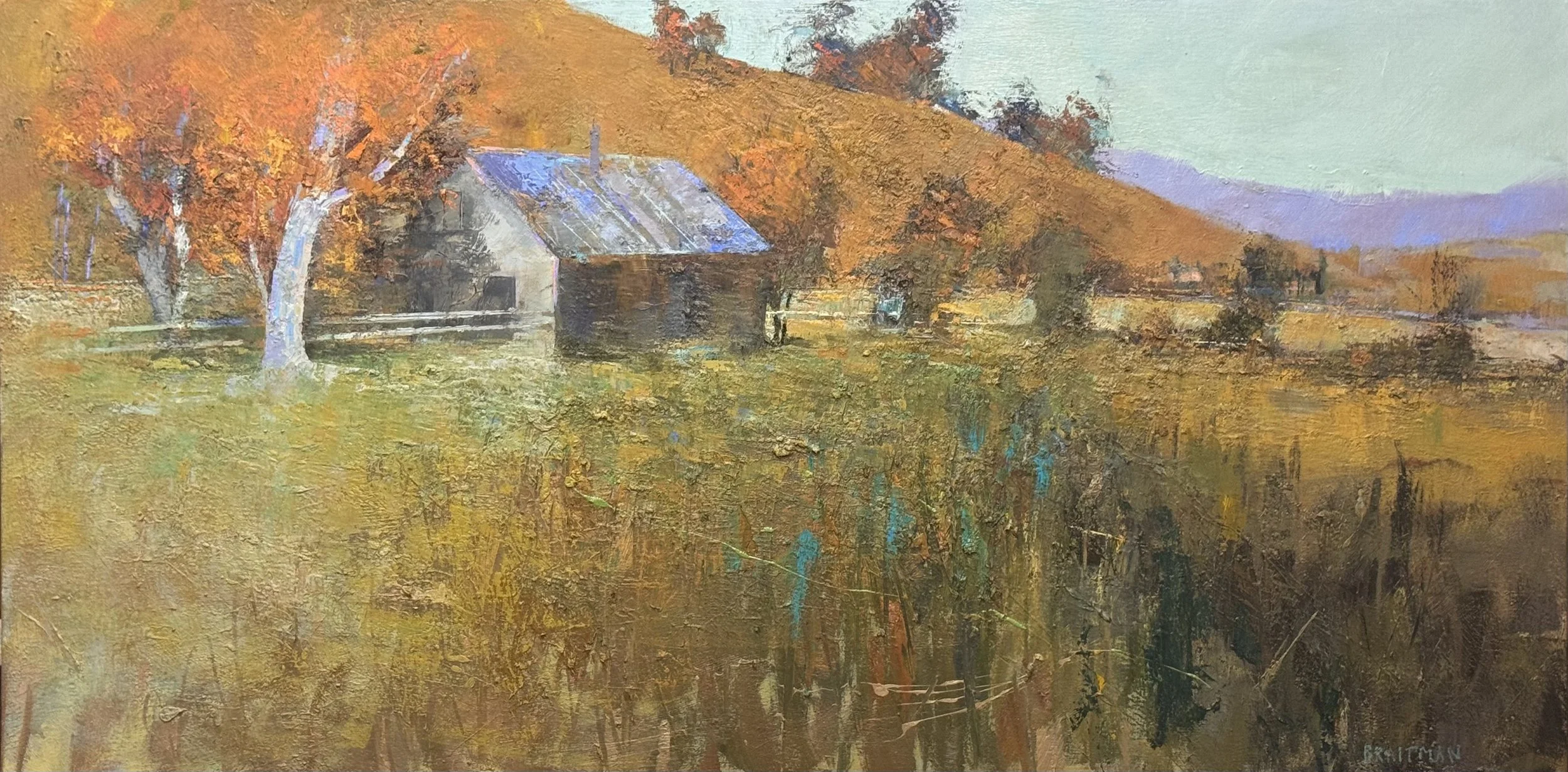
One True Corner
33 x 66 Inches
Feeling vs. Explanation: A Hard-Won Balance
Some paintings give themselves to you. This one didn't.
The struggle was always the same: how much do I explain, and how much do I trust the feeling? Hard edges at the barn pull the eye into clarity. The foreground — grasses, shrubs, fence lines, field passages — pushes back with abstraction and aggression. Getting those two registers to coexist without one apologizing for the other took more sessions than I care to count.
The extreme width of the canvas was the central challenge. The large tree at left acts as the bow of the boat, splitting the eye right or left before the barn corner pulls it into a counter-clockwise rotation — hill, distant mountain, warm field, layered foreground, back to the tree. Around and around, but never stuck.
The blue-violet roof against the burnt orange hill is where the palette declares itself. Two quiet notes that keep this from being a picture of a farm — and make it a place instead.
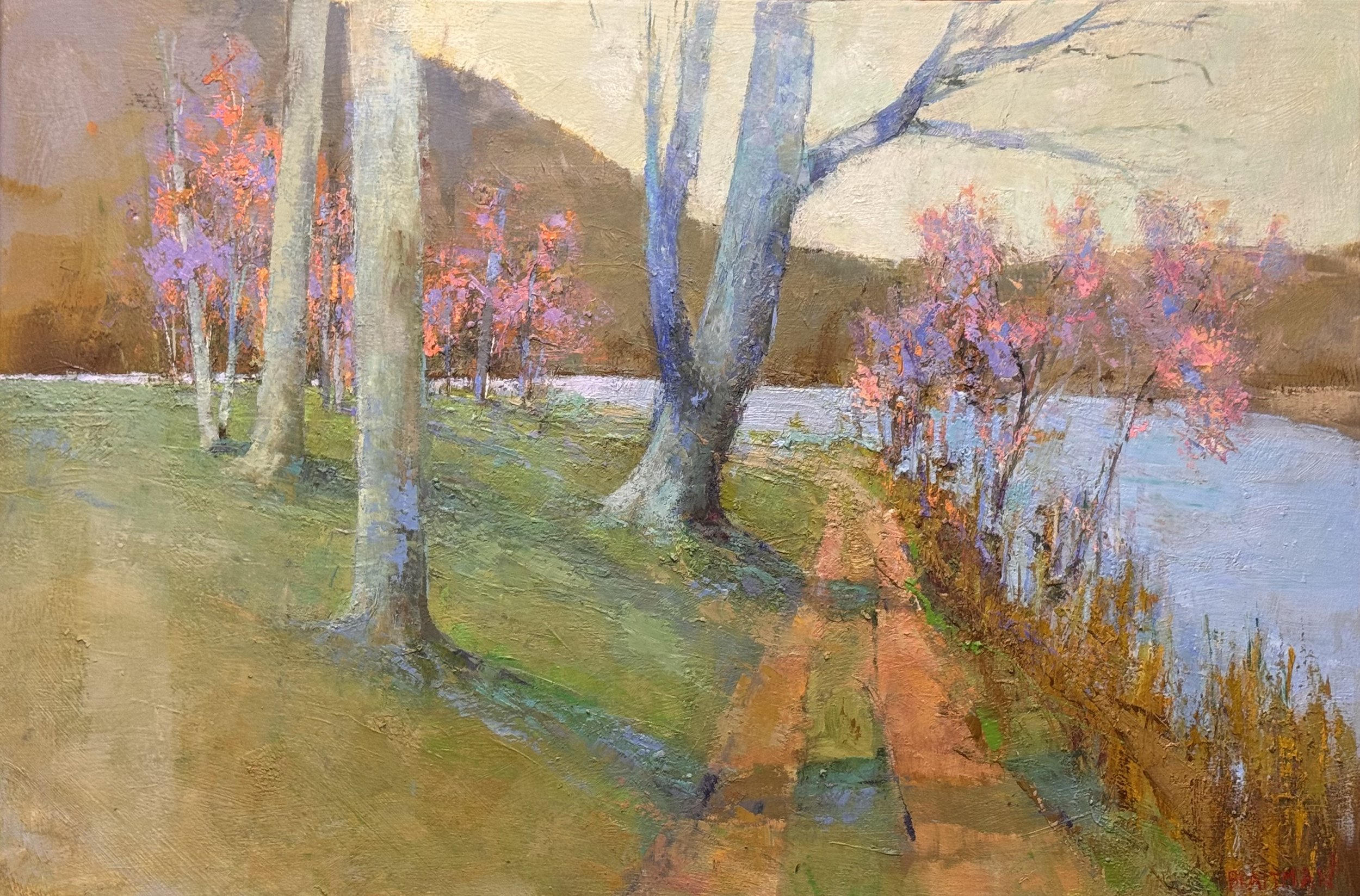
This one is about depth that keeps changing its mind. NEAR AND FAR, 36 X 54 iNCHES
The eye moves in, then pulls back. The foreground trees push toward you — those blue-violet trunks are practically in your lap — while the pink-lit trees behind them step back, then back again toward the hill. The dirt road curves right and slides toward the river, which opens the whole right side into light and distance. Then the near bank pulls you back to earth.
In and out. Near and far. The painting earns its width by never letting you settle.
The tree placement is doing all the structural work — each trunk a different distance, a different color temperature, a different weight. The river isn't the subject so much as the release valve: every inward push eventually exhales into that cool horizontal band of water.
What held this together in the end was resisting the urge to resolve it. The push and pull is the painting.
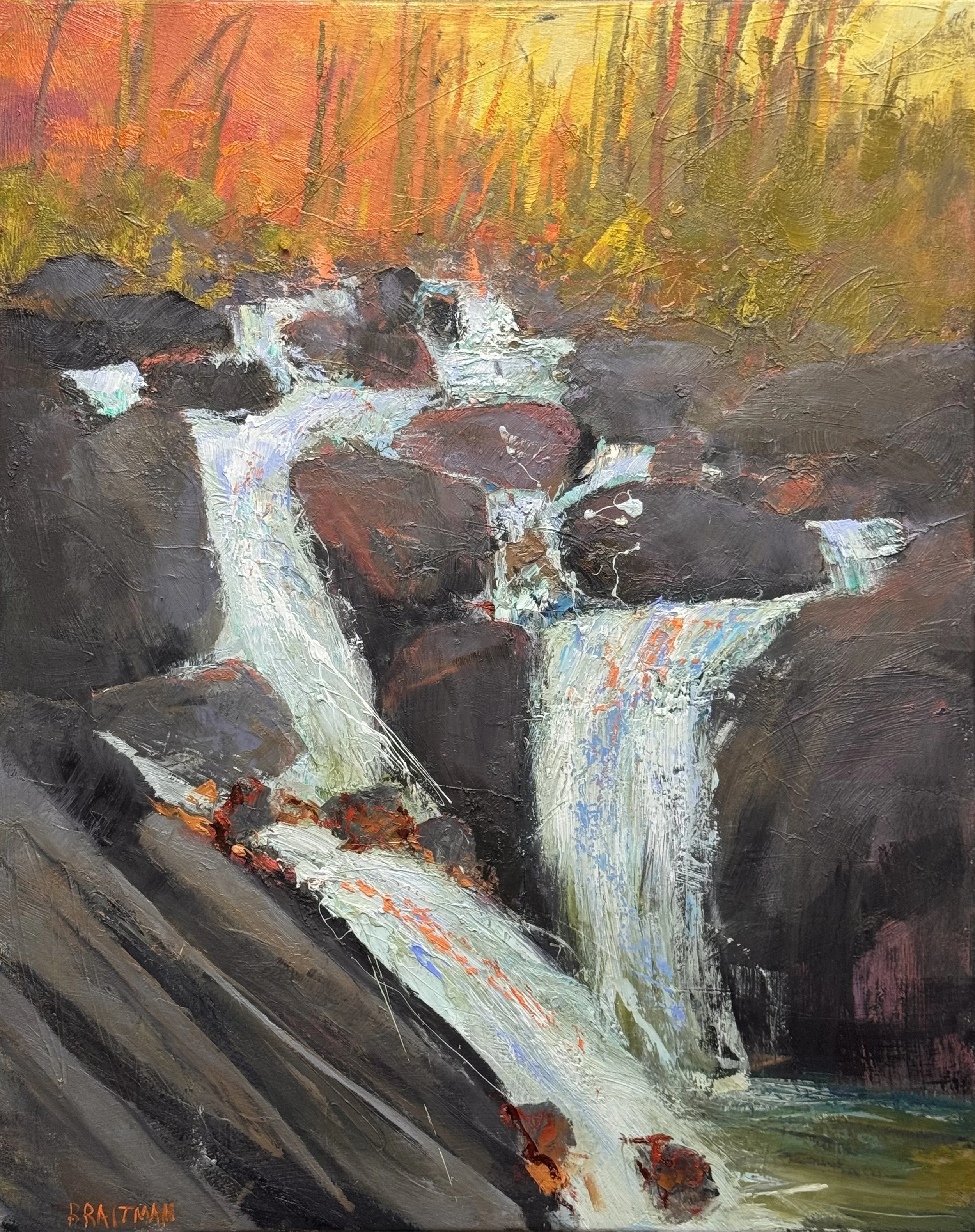
Water doesn't hold still, and neither does this painting.
The cascade moves on a hard diagonal — upper left to lower right — and the dark rock masses on either side are what give it velocity. Without that weight, the white water would just be white paint. With it, it falls.
The final session added two things: a bit more chaos along the cascade edge — dark drawing marks and bronzy red-orange worked into the small stones — and reflected orange and red pulled onto the water's surface. That second decision is the one that matters most. It connects the fall to the burning forest above it, making the whole painting one thermal event rather than a landscape with a waterfall in it.
The palette throughout is fire and shadow. The water is the only thing moving through both.
BURNT CREEK, 48 x 36 inches